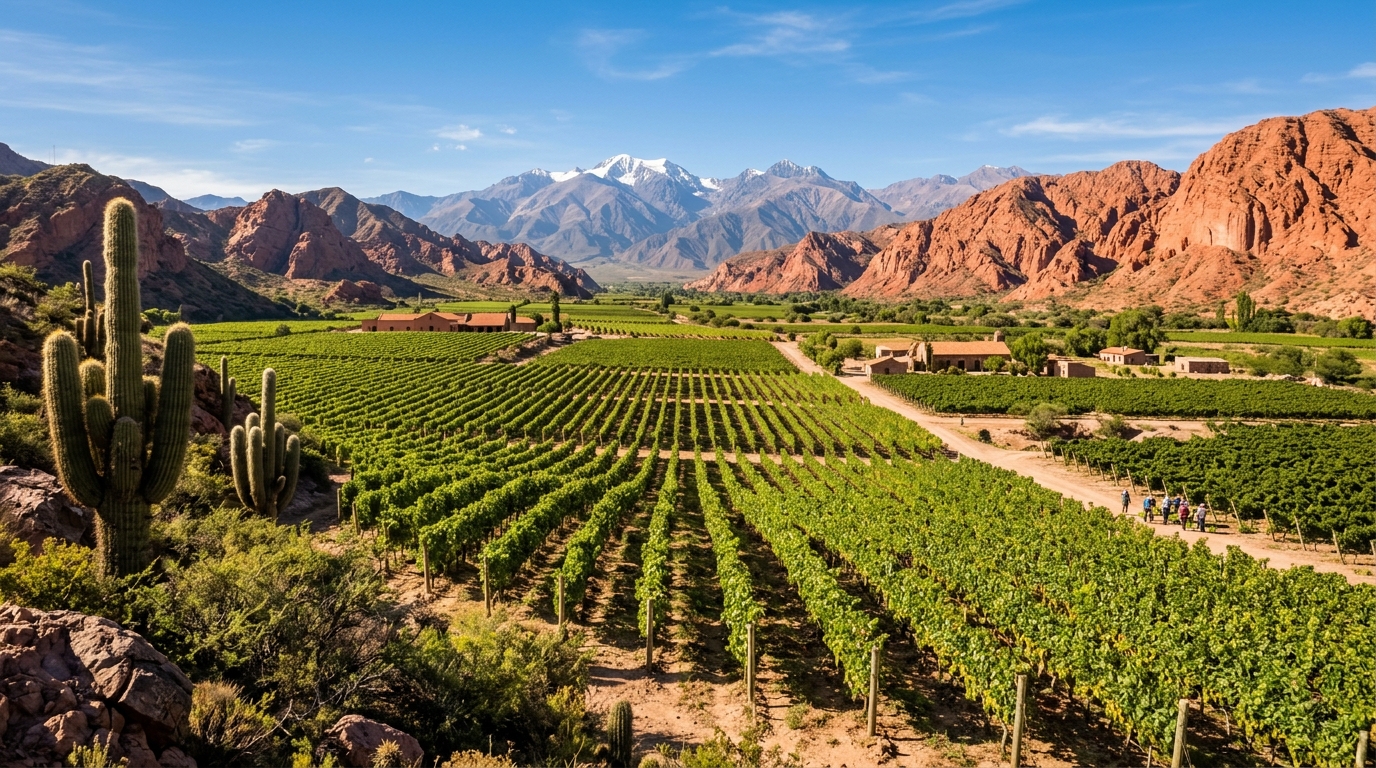
Salta & the Calchaquí Valley: where Argentina's vines touch the sky
A field guide to Argentina's high north — where grapes ripen above 1,700 metres, a white wine smells of jasmine, and the oldest working winery in the country sits at the edge of the clouds.
Most people meet Argentine wine in Mendoza. Salta is what happens when you keep driving — north, and up. The road from Salta city to Cafayate climbs through the Quebrada de las Conchas, a gorge of wind-carved red rock that looks less like wine country than the surface of Mars. Then the canyon opens, the vines appear, and you realise you are standing higher than almost any vineyard on Earth.
This is the Calchaquí Valley: a chain of high desert valleys running roughly 270 kilometres down the spine of the Andes, shared between the provinces of Salta, Catamarca and Tucumán. It holds only a small share of Argentina's vineyards, but a wildly outsized share of its reputation — and almost all of its drama.
Wine grown closer to the sky
Altitude is the whole story here. Most Cafayate vineyards sit around 1,700 metres; others climb past 2,000, 2,400, even 3,000. The air is thin, the sun is fierce, and rain barely falls — often less than 100 mm a year — so the vines drink Andean snowmelt through irrigation.
Two things follow from that. First, the ultraviolet light is so intense that the grapes grow unusually thick skins to protect themselves — and skins are where colour, tannin and aroma live. Second, warm days are followed by sharply cold nights, a swing that can top 20°C. The heat ripens the fruit; the cold locks in acidity and perfume. The result is low yields of small, concentrated, deeply aromatic grapes — wines with vivid colour, freshness, and an almost electric intensity.
Torrontés: Argentina's own white
If Mendoza belongs to Malbec, Salta belongs to Torrontés. Torrontés Riojano is a genuinely Argentine grape, and it reaches its finest expression around Cafayate — where, fittingly, Argentina's oldest recorded living vine is a Torrontés planted back in 1862.
It is a wine that fools people. The nose is extravagant — jasmine, orange blossom, white peach, rose — so floral that you brace for something sweet. Then the palate arrives dry, fresh, and faintly bitter on the finish, like good grapefruit pith. Served cold on a hot Cafayate afternoon, it is very hard to beat, and it loves the local table: empanadas salteñas, goat cheese, anything with a whisper of chilli.
Malbec, but not as you know it
Salta is not only whites. In Cafayate, Malbec is actually the most-planted grape — and high-altitude Salta Malbec is its own creature. Where a classic Luján de Cuyo Malbec is plush and rounded, a Salta Malbec is tighter, darker and more savoury: black fruit, violets, crushed pepper, a herbal “mountain dust” edge, and firm structure from all that thick skin. If Mendoza Malbec is velvet, Salta Malbec is suede.
The valley, stop by stop
Cafayate is the heart — a relaxed adobe town built around a leafy plaza and ringed by wineries you can reach on foot or by bike. It holds the majority of Salta's vines and most of its visitor-ready bodegas, from large historic houses to tiny organic family projects.
The drive itself is half the reason to come. The Quebrada de las Conchas, on the route between Salta city and Cafayate, is a parade of red sandstone amphitheatres and gorges; its most famous formation, the Garganta del Diablo (Devil's Throat), is a stop in its own right.
Deeper into the valley, along the legendary Ruta 40, the road climbs through Molinos and Cachi toward the most extreme vineyards of all. This is the home of Bodega Colomé, founded in 1831 — the oldest continuously working winery in Argentina. Its “Altura Máxima” vineyard, planted at 3,111 metres, is one of the highest in the world; the estate even keeps a museum devoted to the light artist James Turrell. Getting there is a long mountain journey — and that remoteness is exactly the point.
How it compares to Mendoza
Think of it this way: Mendoza is Argentina's grand, polished wine capital — easy to reach, rich in great restaurants and big estates. Salta is wilder, higher, harder to get to, and unforgettable for precisely that reason. Many travellers do both; but if you only have time for one and you want scenery that stops your breath, Salta wins.
When to go
Harvest runs roughly February to April, when the valley is busiest and most alive. The shoulder months on either side are quieter and still warm by day. Whenever you come, pack layers: at this altitude a hot afternoon can turn into a cold, star-blazing night within the hour.
At a glance
- Country
- Argentina (high north)
- Position
- Calchaquí Valleys, along the Andes
- Spans
- Salta · Catamarca · Tucumán (~270 km)
- Altitude
- ~1,700–3,111 m
- Climate
- High desert, <100 mm rain a year
- Flagship white
- Torrontés
- Flagship red
- High-altitude Malbec
- Hub town
- Cafayate
- Highest vineyard
- Colomé “Altura Máxima” — 3,111 m
- Harvest
- February–April
Quick answers
Why is Salta wine grown so high?
The Calchaquí Valleys lie in the high Andean north, where the flat, watered land suitable for vines happens to sit well above 1,700 metres. Far from a problem, the altitude — intense sun, cool nights, dry air — is exactly what gives the wines their colour, freshness and aromatic power.
What wine is Salta famous for?
Torrontés, Argentina's signature aromatic white, which reaches its peak around Cafayate. Salta also makes distinctive high-altitude Malbec and Cabernet Sauvignon.
Is Torrontés a sweet wine?
No — and that's the classic surprise. It smells intensely floral, almost sweet, then lands dry, fresh and faintly bitter on the finish. That very contrast is what makes it shine at the table — try it well chilled with empanadas salteñas or a slice of goat cheese.
Where is the highest vineyard in the world?
One of the very highest is Bodega Colomé's “Altura Máxima” in Salta, planted at 3,111 metres above sea level.
Is Salta or Mendoza better for a wine trip?
Different, not better. Mendoza is bigger, easier and more polished; Salta is higher, wilder and more scenic. If you can, visit both.


