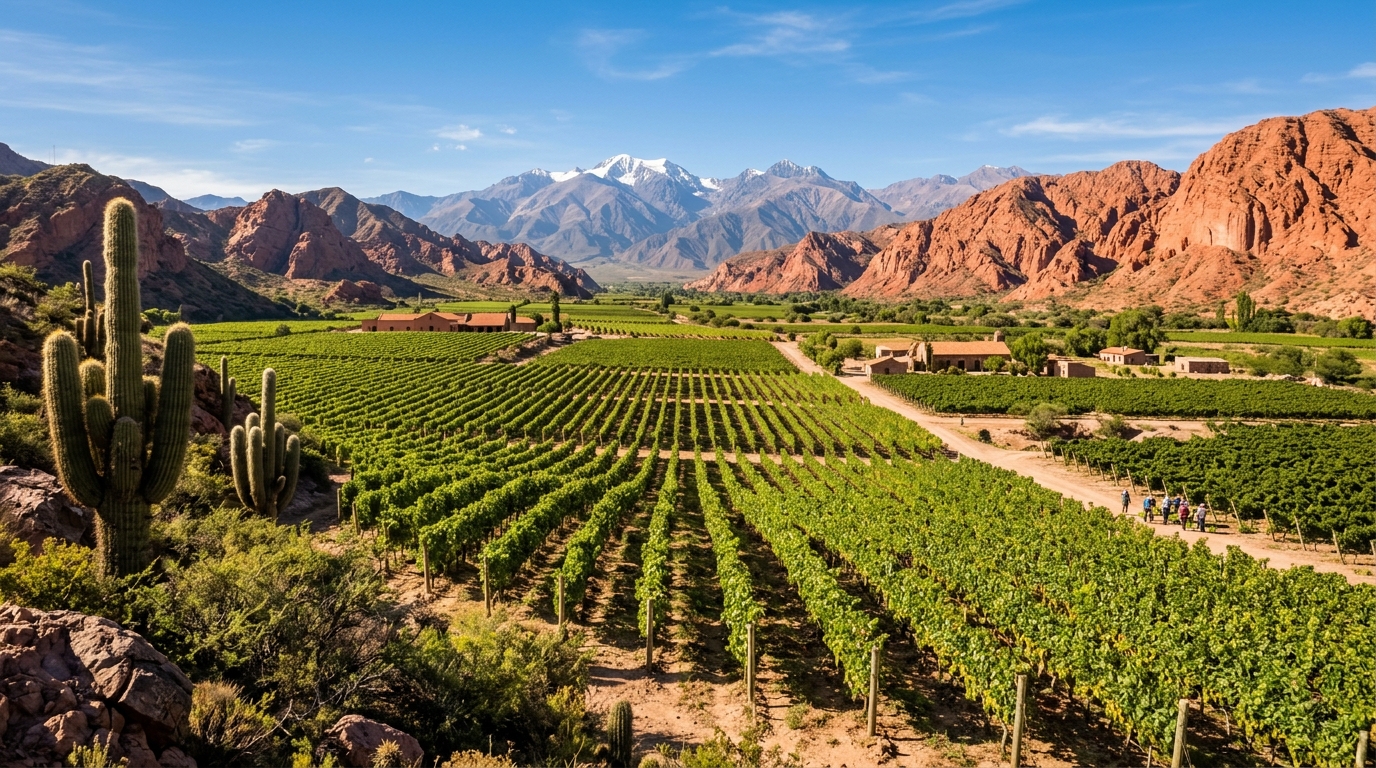
Cafayate: Vines in the Calchaquí Desert Sky
At 1,700 to 3,111 metres, adobe bodegas, red sandstone gorges, and ancient vines produce Argentina's most extreme, wild-fruited wines.
The Oasis at 1,700 Metres
Cafayate is the beating heart — a relaxed adobe town built around a leafy plaza and ringed by historic wineries you can reach on foot or by bicycle. It holds the vast majority of Salta's vines and most of its visitor-ready bodegas, from large historic houses like El Esteco to tiny organic family projects like San Pedro de Yacochuya.
The drive itself is half the reason to come. The Quebrada de las Conchas, along scenic Route 68 between Salta city and Cafayate, is a jaw-dropping parade of red sandstone amphitheatres and wind-carved gorges; its most famous natural monument, the Garganta del Diablo (Devil's Throat), is a sacred stop in its own right.
The Cloud-Scraping Vineyards of Ruta 40
Deeper into the valley, along the legendary Ruta 40, the road climbs through Molinos and Cachi toward the most extreme vineyards on Earth. This is the home of Bodega Colomé (founded in 1831) — the oldest continuously working winery in Argentina. Its Altura Máxima vineyard, planted at 3,111 metres, yields intensely aromatic grapes kissed by raw UV light.
Visiting Cafayate feels like stepping back into old-world Argentina: slow afternoon siestas, empanadas salteñas baked in clay wood ovens, and chilled Torrontés under pergola shade.
Up next, Chapter 3 of 4 If Mendoza belongs to Malbec, Salta belongs to Torrontés. Read Chapter 3: Torrontés country →