Everyone orders the Malbec. This is what Argentines actually drink at lunch.
Torrontés smells like a dessert and drinks bone-dry. It's Argentina's greatest white secret — and the first thing any sommelier in Mendoza pours when the sun is still high.
The wine that tricks you in the best possible way
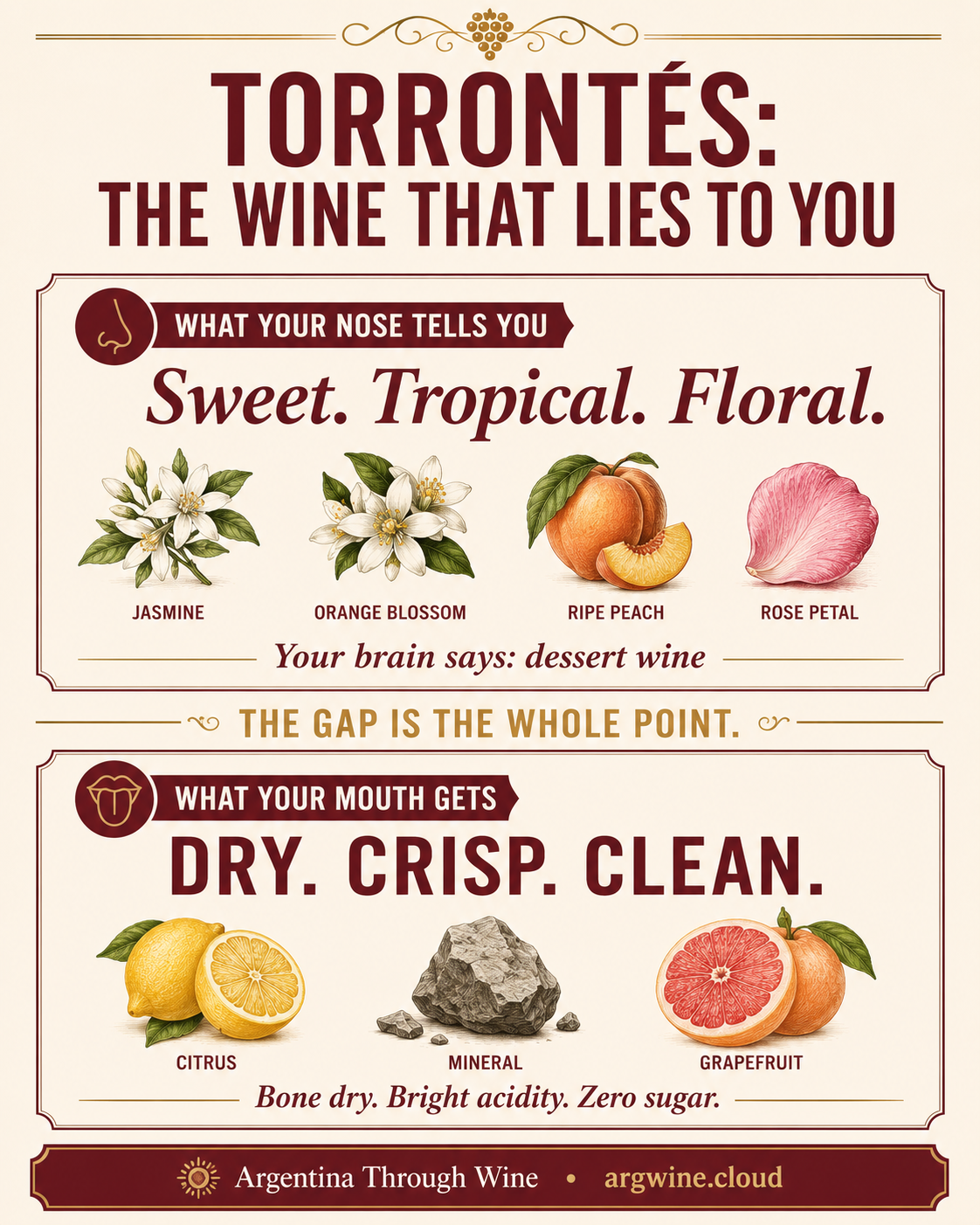
Pour a glass of Torrontés for someone who doesn't know it. Watch their face. They raise it to the nose and get a hit of jasmine, ripe peach, orange blossom — the unmistakable smell of something sweet and indulgent. Their brain says: dessert wine. Light, sticky, probably too much.
Then the wine lands on the palate, and everything changes. It's bone-dry. Crisp. Clean. There's a citrus bite at the finish — grapefruit pith, a little mineral edge — and then it's gone, leaving you refreshed rather than full.
The gap between what Torrontés promises on the nose and what it delivers on the palate is the whole point. It's one of wine's great tricks — and once you know it, you can't stop ordering it.
"I've never met anyone who tried Torrontés and didn't immediately want another glass. The nose gets you curious. The palate gets you hooked."
Why it smells like that
Torrontés is Argentina's own grape — one of the few varieties the wine world agrees is genuinely, originally Argentine. It's a natural cross between Muscat of Alexandria and Criolla Chica, and it inherited Muscat's extraordinary aromatic intensity without its sweetness.
That's the genetic trick at the heart of Torrontés: the aromatic compounds that smell sweet are present in huge quantities, but the fermentation goes to dryness. There's no residual sugar. The wine smells like a garden in bloom and tastes like it's been left in the sun on a cold morning — warm on the nose, clean and cool in the mouth.
Where the best comes from
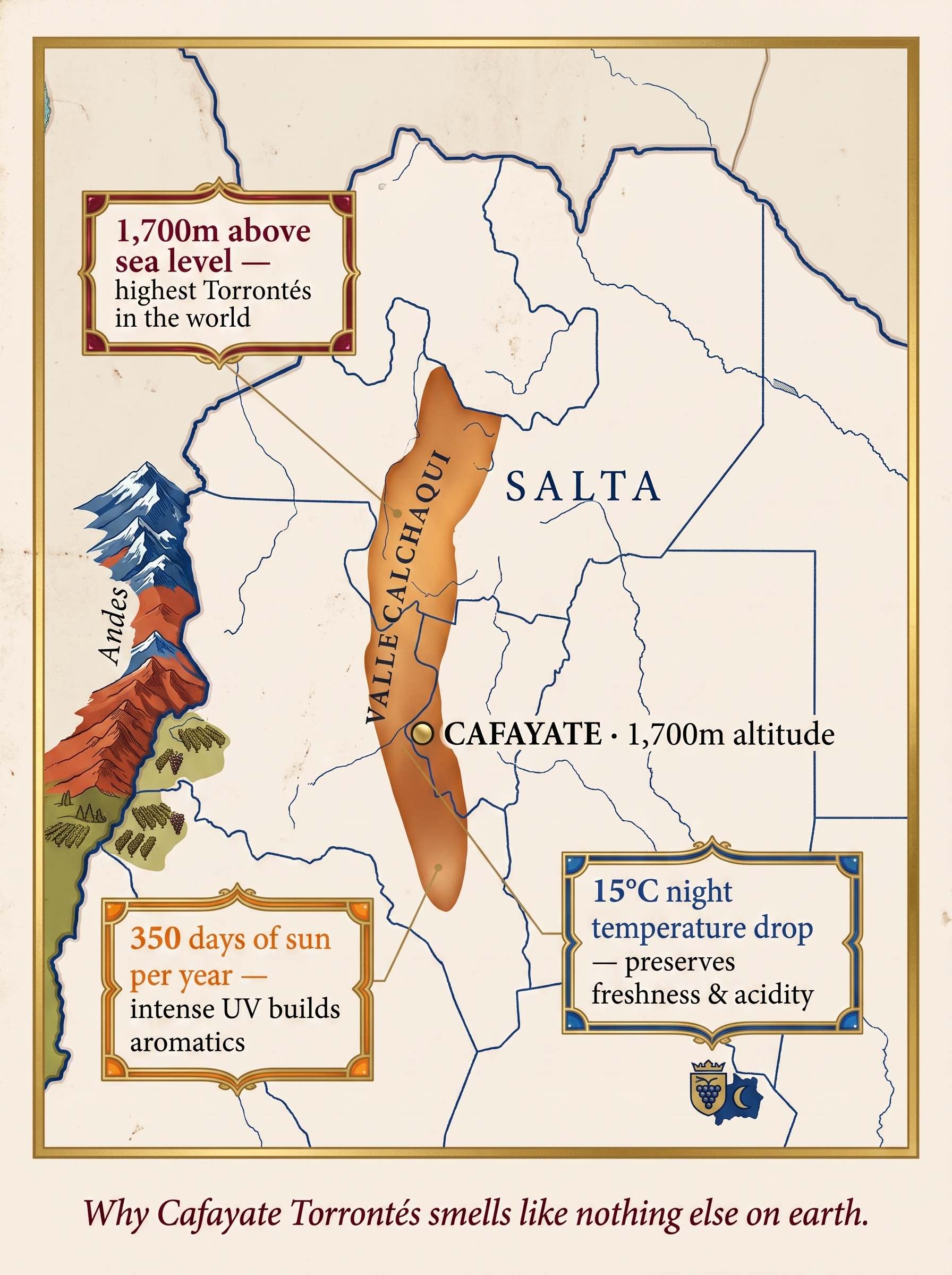
Torrontés grows across Argentina — Mendoza, La Rioja, San Juan — but its finest expression comes from Cafayate, in the Calchaquí Valley of Salta, in the high north of the country.
At 1,700 metres above sea level, Cafayate sits higher than almost any commercial wine region on earth. The altitude does two things simultaneously that seem contradictory: the intense UV radiation from the thinner atmosphere concentrates the grape's aromatic compounds to almost unreasonable levels — that's why the perfume is so powerful — while the cold nights, dropping 15°C or more from the daytime high, preserve the acidity that keeps the wine dry, fresh, and alive.
The result is a wine that smells like the warmest, most fragrant afternoon of the year and drinks like the coolest, freshest morning. It's a sensory contradiction that shouldn't work. It does.
"Cafayate at 1,700 metres: where the sun bakes the aroma into the skin and the cold night saves the acidity. There's nowhere else on earth this wine happens."
Why tourists miss it
Walk into almost any restaurant in Buenos Aires or Mendoza and ask for Argentine wine. The waiter brings Malbec. Always. It's what Argentina is known for, what the wine lists lead with, what the tourist expects.
Meanwhile, at the staff table, at the kitchen pass, in the corner where the sommelier eats lunch after service — there's usually a bottle of Torrontés open, half-finished, sweating in the heat.
It's not that Malbec is wrong. It's that Torrontés is the wine that actually makes sense with the food: with empanadas at noon, with provoleta still hot from the grill, with ceviche, with anything where you want something cold and aromatic and completely, perfectly dry.
Tourists order what they know. Argentines drink what works.
What to eat with it
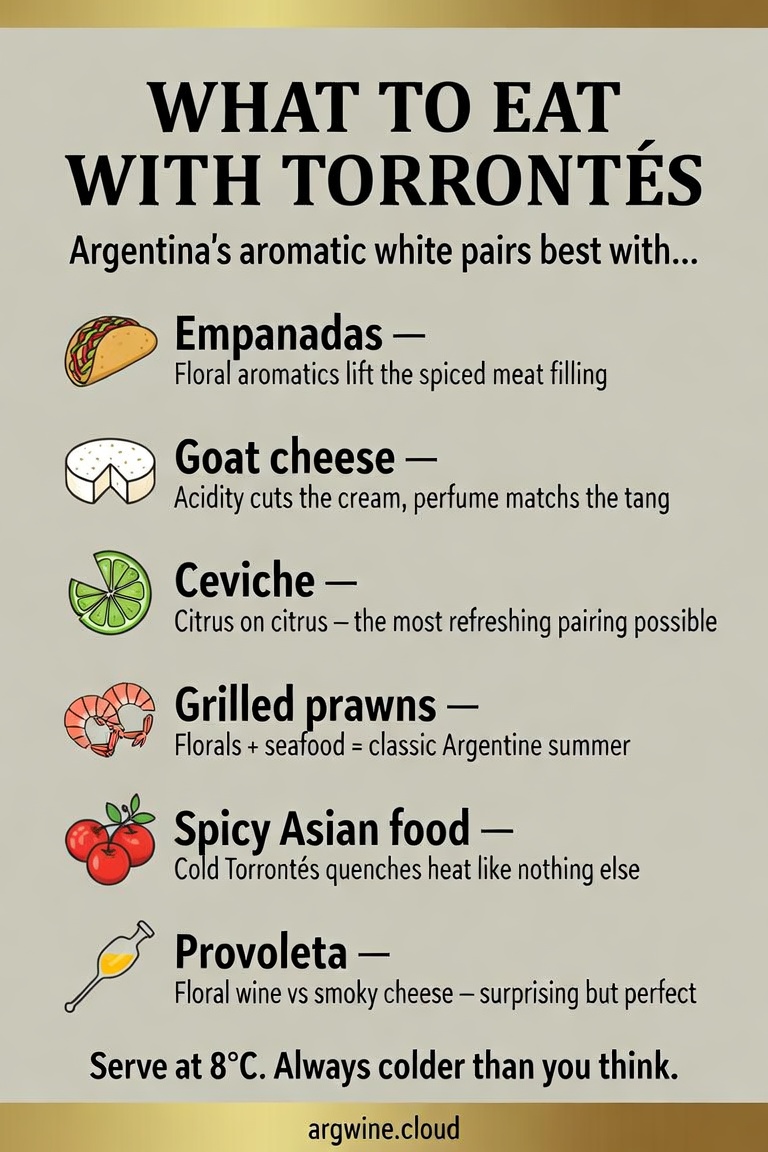
The pairing logic is straightforward once you understand the wine: Torrontés brings intense perfume and bright acidity. You want food that plays off one or both.
Empanadas — the floral aromatics lift the spiced meat filling; the acidity cuts through the pastry. Classic.
Goat cheese — acid against cream, perfume against tang. One of the great Argentine combinations.
Ceviche — citrus on citrus. The wine amplifies the lime, the lime sharpens the wine. Order two glasses.
Grilled prawns — floral white with seafood is a South American tradition. Simple, cold, perfect.
Spicy food — cold Torrontés served at 8°C quenches chilli heat better than beer. The sweetness of the nose fools the mouth into calm.
Provoleta — smoky grilled cheese against aromatic white. Surprising on paper. Obvious in the glass.
One rule above all: serve it cold. Colder than you think — 7 or 8°C. At room temperature the perfume becomes overwhelming. Cold, it's everything it should be.
We may earn a small commission on bookings — at no extra cost to you. Read our disclosure.
What to look for on the bottle
The label will almost always say Torrontés Riojano — the sub-variety that produces the finest wine (there are three Argentine Torrontés; this is the best). Look for Cafayate or Calchaquí Valley on the label if you want the full altitude effect. Producers worth seeking out: Clos de los Andes, El Esteco, Crios by Susana Balbo, and Zuccardi Serie A.
Price point: the best Torrontés overdelivers dramatically for the money. You rarely need to spend more than $18–25 to get something extraordinary. The grape doesn't need oak or time — it's at its best young, cold, and honest.
Continue reading
- → Complete Torrontés guide: taste, regions & producers
- → Malbec: the grape that almost died in France
- → Empanadas wine pairing: the full guide
- → The story: Malbec almost died in France. Argentina saved it.
- → Cafayate: wineries, altitude & what to do in Argentina's wine village
- → Wine tours in Argentina — small-group tastings in Mendoza & Salta
Quick answers
Is Torrontés sweet or dry?
Bone-dry — that's the famous surprise. It smells intensely floral and sweet (thanks to its Muscat parentage), but a well-made Torrontés finishes dry, fresh and clean with no residual sugar.
What does Torrontés taste like?
Jasmine, orange blossom, ripe peach and rose on the nose — then dry, medium-bodied, with citrus freshness and a faint grapefruit-pith bitterness on the finish. Nothing like it smells.
Where does the best Torrontés come from?
Cafayate in Salta's Calchaquí Valley, at 1,700 metres above sea level. The altitude intensifies the aromatics while cold nights preserve the acidity that keeps it dry and fresh.
What temperature should I serve Torrontés?
Colder than you think — 7 to 8°C. At room temperature the perfume becomes overwhelming. Cold, it's perfectly balanced and completely refreshing.