Malbec Almost Died in France.
Argentina Saved It.
In 1956 a single frost nearly erased this grape from the world. The story of how a variety France abandoned became the soul of Argentine wine — and why it now tastes like nowhere else on earth.
The night that almost ended Malbec
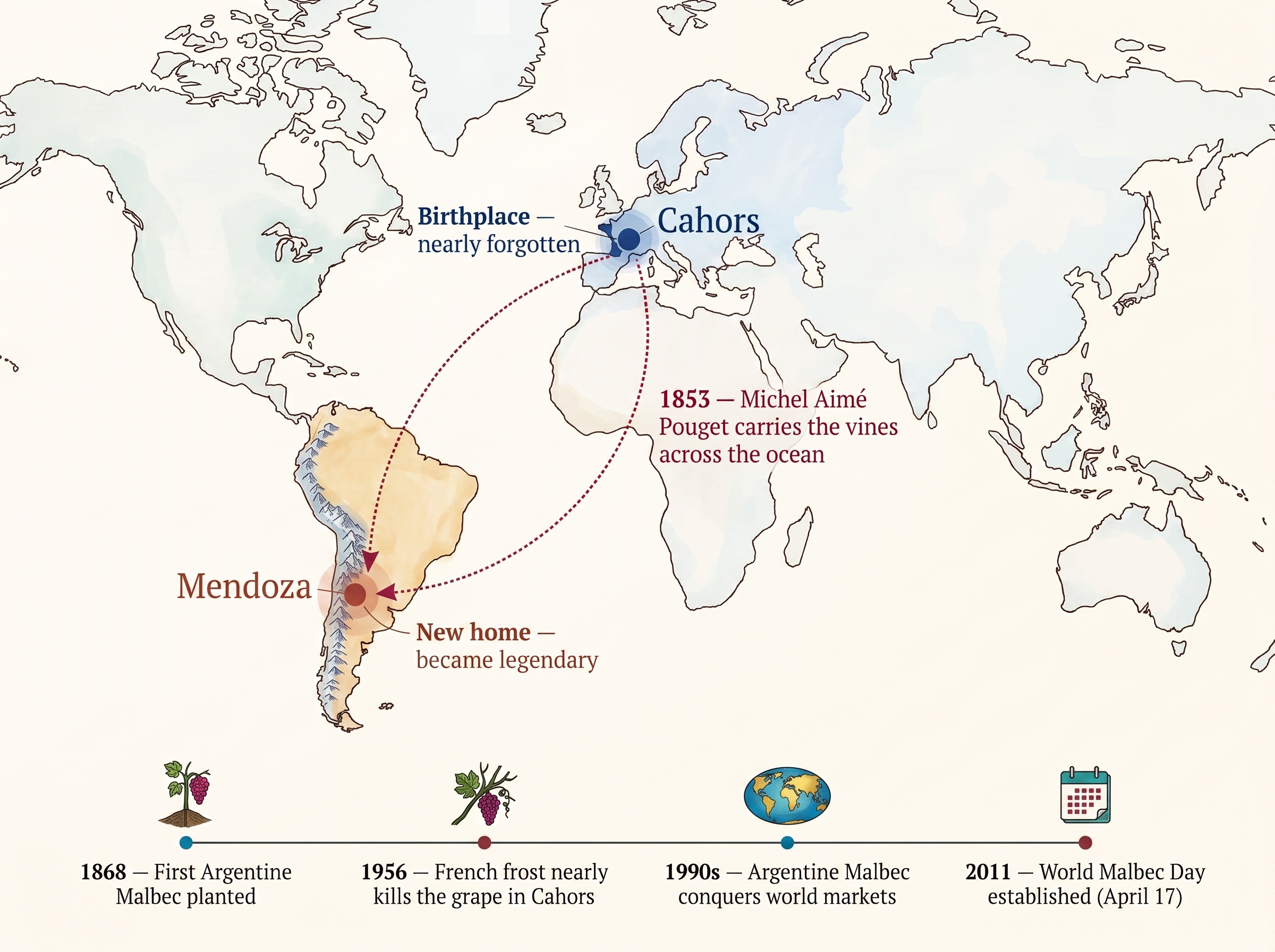
In February 1956, temperatures across southwest France plummeted to −20°C. The frost lasted days. In the Cahors wine region — the historical home of Malbec — it killed an estimated 75% of the vines overnight.
For many growers, it was the final straw. Malbec was already a difficult grape: prone to rot, inconsistent in cold years, stubbornly tannic when it didn't fully ripen. After the frost, many simply replanted with easier varieties. Malbec shrank to a supporting role in Bordeaux blends and a regional curiosity in Cahors. The world mostly forgot it.
"The grape that almost vanished from France had already been growing in Argentina for over a century — and it had been quietly becoming something else entirely."
How it got to Argentina
In 1853, the Argentine president Domingo Faustino Sarmiento hired a French agronomist named Michel Aimé Pouget to modernise the country's agriculture. Pouget brought vine cuttings from France — dozens of varieties — and Malbec was among them. Not because it was the finest grape. Because it was available, robust, and productive.
Nobody planned for Malbec to become Argentina's signature. It simply arrived, got planted, and survived. While France hesitated over its difficult child, Argentina had no such doubts. The vines went in. The wine got made. And then something unexpected started happening in the glass.
What the Andes did to it
Mendoza sits at the foot of the Andes, between 900 and 1,500 metres above sea level. That altitude changes almost everything about how a grape ripens.
The sun at altitude is more intense — the thinner atmosphere filters less UV radiation, which thickens grape skins and deepens colour. But the nights are cold, often dropping 15–20°C from the daytime high. That temperature swing is the secret: it forces the grapes to retain acidity even as their sugars build, producing wine that is ripe and full-flavoured yet stays fresh and balanced.
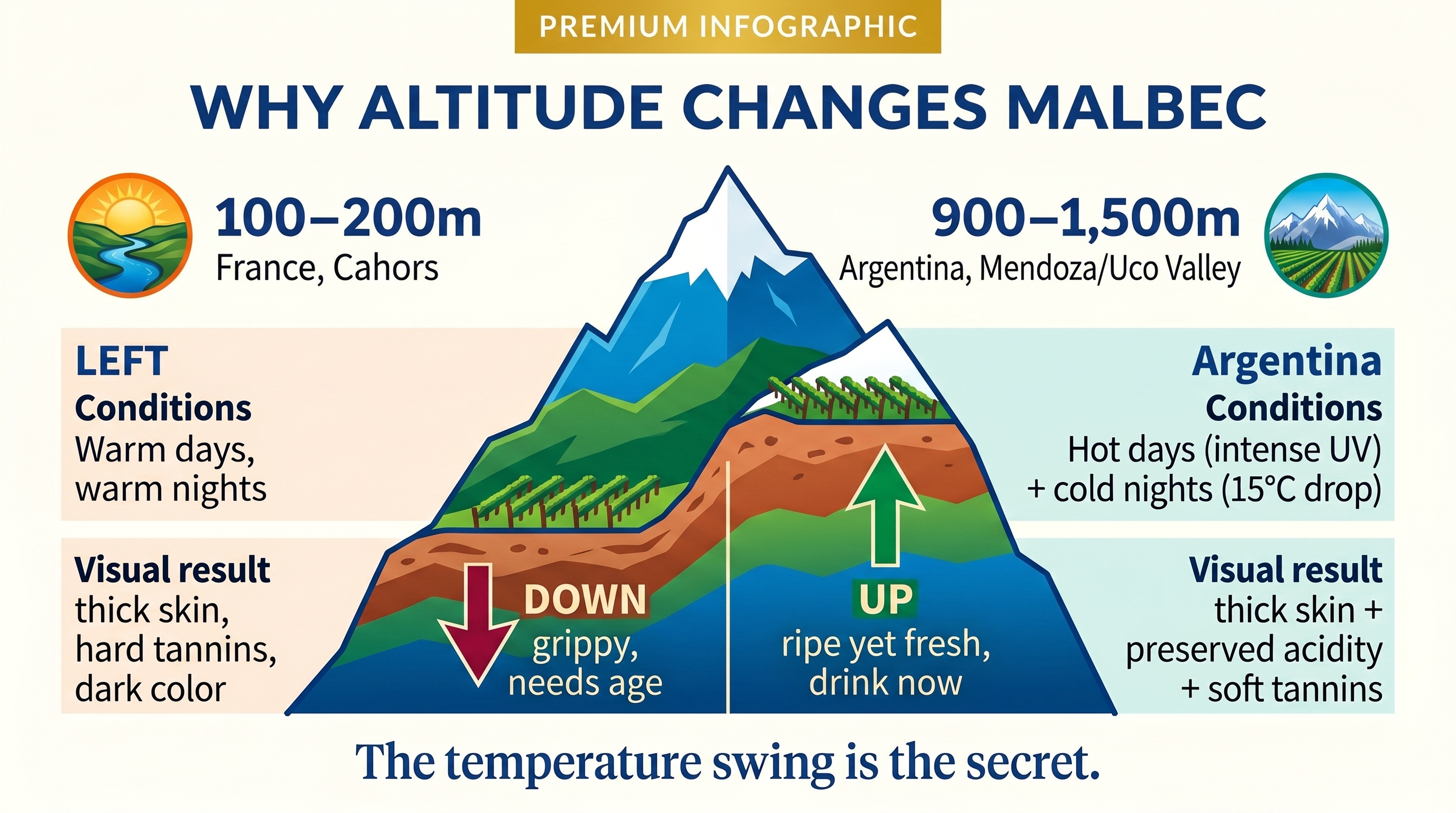
The result was a wine French Malbec had never managed to be: soft-textured, with tannins that felt like velvet rather than grip; fruit that leaned toward blackberry and violet rather than dark plum and leather; a colour so deep it seemed to hold light rather than absorb it.
Argentine winemakers didn't understand exactly why for a long time. They just knew it tasted good. That was enough.
"French Malbec needs a decade to open. Argentine Malbec invites you in on the first sip."
When the world noticed
For most of the 20th century, Malbec in Argentina was a workhorse grape — used for everyday table wine, drunk locally, not exported. The real turning point came in the 1990s, when a handful of Mendoza producers — Nicolas Catena Zapata among them — started treating it seriously: lower yields, careful vineyard selection, new French oak barrels. The wine that came out was remarkable. International critics tasted it. Scores went up. Export orders followed.
By the 2000s, Argentine Malbec was one of the fastest-growing wine categories in the world. By 2011, there was a dedicated World Malbec Day — celebrated every 17 April. Not in Cahors. In Buenos Aires.
Why the two versions taste so different
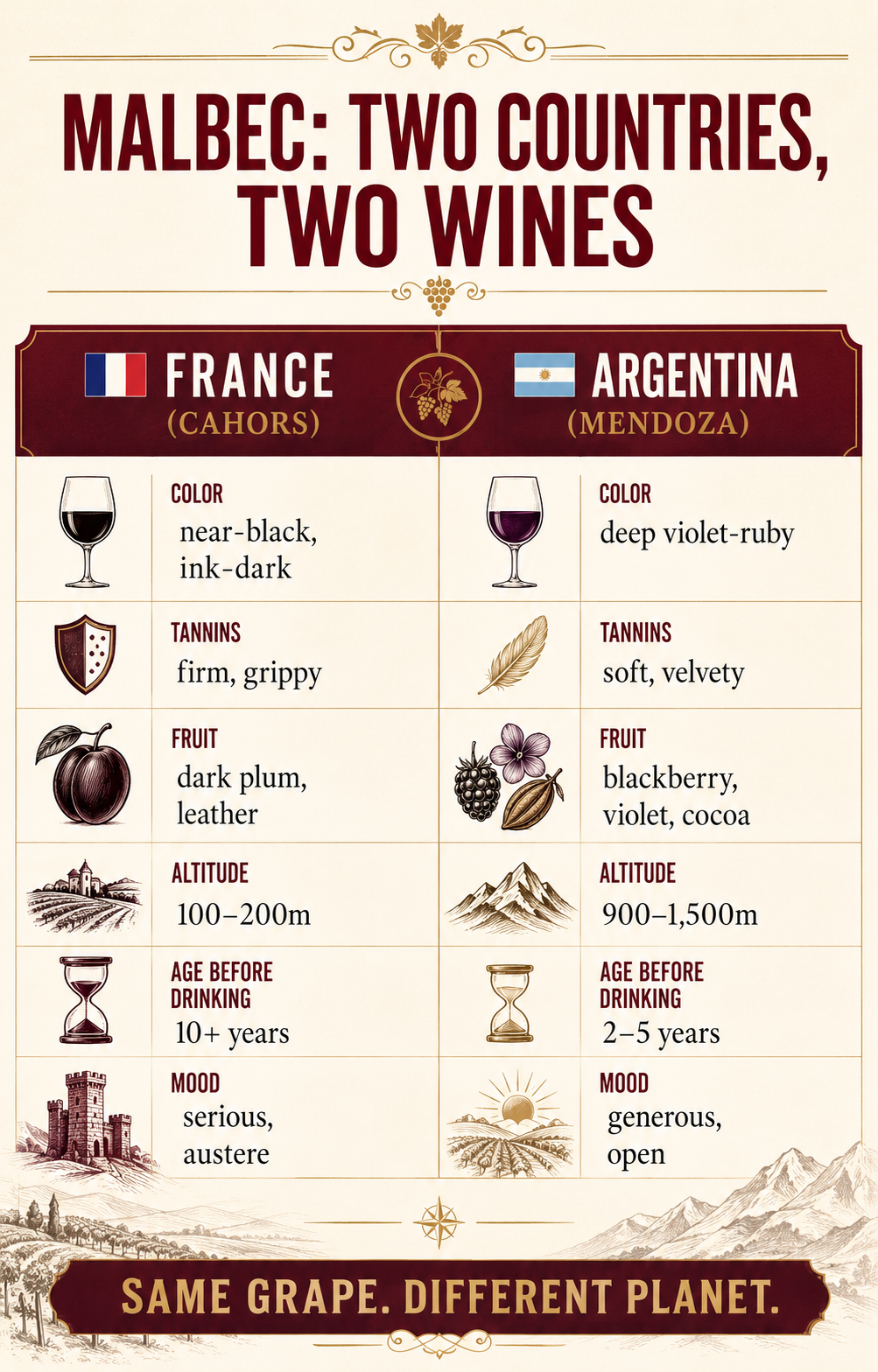
Today, both countries still make Malbec. They barely seem related. French Cahors Malbec (where it's known as Côt) is dark, stern and structured — a wine that rewards patience, that needs years in a cellar to show its complexity. It is serious in the way that serious French wines are serious: it does not flatter easily.
Argentine Malbec is the opposite of all that. It is generous from the first pour: ripe black fruit, a violet lift on the nose, cocoa or mocha from oak if it's seen a barrel, and tannins so smooth they barely register as tannins at all. It's a wine that works with food or without it, at a restaurant table or straight from the bottle at an asado.
The grape didn't change. The place did.
What to drink now
If you want to understand what the altitude does, taste Malbec from three altitudes side by side:
- Maipú (600–700m) — warm, generous, easy-drinking. The everyday face of Malbec.
- Luján de Cuyo (900–1,100m) — riper, more structured, classic. This is where Catena Zapata and Achaval Ferrer work.
- Uco Valley (1,100–1,500m) — the highest, freshest, most elegant. Wines from Zuccardi and Clos de los Siete show what altitude alone can do.
We may earn a small commission on bookings — at no extra cost to you. Read our disclosure.
The irony
France has been replanting Malbec in Cahors since the 1970s, and quality there has improved dramatically. Some modern Cahors producers are making Malbec that is genuinely world-class — and the comparison with Argentina is now interesting rather than unflattering.
But Argentina already won. Malbec is Argentine in the popular imagination, and that's unlikely to change. The grape that almost disappeared from its birthplace found, at altitude in the southern hemisphere, the conditions to become itself — fully, extravagantly, irreversibly.
The frost of 1956 was a disaster. It was also, for Argentine wine, the best thing that ever happened.